NOTE · 2020笔记 · 2020
Positive Semidefinite Matrix in Machine Learning
Positive Semidefinite Matrix is closely associated with some of machine learning algorithms.
What is Positive Semidefinite (PSD) Matrix
Definition
Matrix A \in \mathbb{R}^{n\times n} is positive semi-definite (PSD), denoted A \succeq 0, is defined as:
- A = A^{T} (A is symmetric)
- x^{T}Ax \geq 0 for all x \in \mathbb{R}
So from the definition, we can infer some properties of PSD matrix.
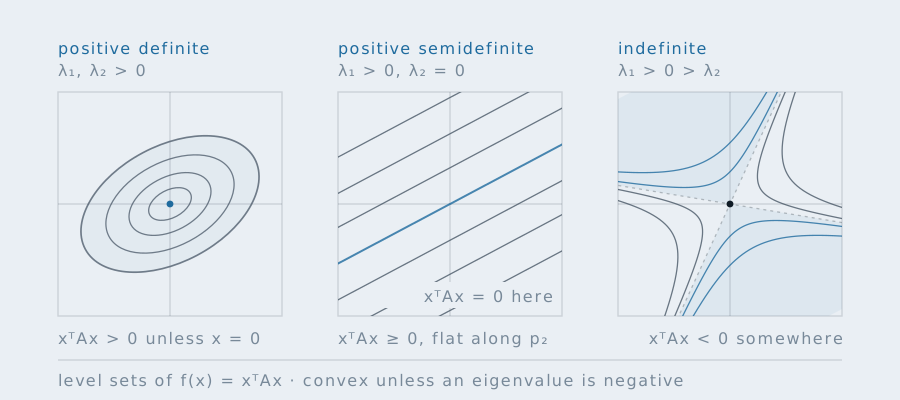
The definition is easiest to hold onto through the level sets of f(x) = x^TAx. Positive definite gives a bowl, the semidefinite-but-singular case gives a trough with a flat direction, and one negative eigenvalue is enough to open a saddle — and with it a region where x^TAx < 0.
Properties
-
If A \succeq 0 then A is invertible and A^{-1} \succeq 0.
-
If A \succeq 0 , then \forall Q \in \mathbb{R}^{n\times n}, we have Q^{T}AQ \succeq 0.
-
A \succeq 0 \iff \text{Eigenvalues of } A \geq 0 (A is PSD if and only if all the eigenvalues of A are non-negative)
-
For a semidefinite matrix A, we can find two matrices P and D \in \mathbb{R^{n\times n}}, such that
M = P^{-1}DP(1) where P is an orthogonal matrix, P = [p^{(1)},p^{(2)},\dots,p^{(n)}] , p^{(i)} are eigenvectors of A; and D is a diagonal matrix whose main diagonal contains the corresponding eigenvalues. This is called an eigen decomposition of M.
Why Is It Important in Machine Learning
There are some connections that I found (though I believe they are not the whole picture) between PSD matrix and machine learning algorithms. Here are these connections.
Covariance Matrix of a Multi-variate Random Variable is PSD
For example, \overrightarrow X = [X_1, X_2, \dots, X_n] \in N(\mathbf{\mu}, \mathbf{\Sigma}), is a multivariate Gaussian distribution where each X_i \in N(\mu, \sigma_i^2) is a Gaussian distribution and every linear combination of X_is has a univariate normal distribution. The covariance matrix \mathbf{\Sigma} is a positive semidefinite matrix, where (i,j) entry is the covariance (or variance):
Quadratic Form of a PSD is Convex
If A is a PSD matrix, then the quadratic form f(\mathbf{x}) = x^TAx is a convex function. This is the first two panels of the figure above: a bowl and a trough are both convex, and the trough shows that “semi” only costs you a flat direction, not convexity. The saddle in the third panel is what convexity rules out. (In fact \nabla f(\mathbf{x}) = Ax and \nabla^2 f(\mathbf{x}) = A). Idea of proof: f(\mathbf{x}) = \sum_{i=1}^n\lambda_i z_i^2 , where \lambda_i are eigenvalues of A , and z_i = Px_i is a changing-based x_i. This proof used the fact that PSE can be diagonalized.
Another property , that is similar, is listed here without explanations:
A twice differentiable function f:\mathbb{R}^n \to \mathbb{R} is convex, if and only if the Hessian \nabla^2 f(x) is positive semi-definite for all x \in \mathbb{R}^n.
Spectral Theorem and Eigenvalues
If A\in \mathbb{R}^{n\times n} is symmetric, then A has n orthogonal eigenvectors with real eigenvalues.
- Spectral Theorem
Along with the property that A‘s eigenvalues are \geq 0, we can conclude that:
Programming
Semidefinite programming (SDP) is a subfield of convex optimization concerned with the optimization of a linear objective function (a user-specified function that the user wants to minimize or maximize) over the intersection of the cone of positive semidefinite matrices with an affine space.
Quadratic programming could be simplified if A is positive definite. The problem is a special case of the more general field of convex optimization.