Experience经历
Research Scientist, AI人工智能研究科学家
STANFORD MEDICINE · GEVAERT LAB, COMPUTATIONAL MEDICINE斯坦福医学院 · 计算医学部 GEVAERT 实验室
A chest-CT foundation model for lung tumor analysis (first author, manuscript in preparation). Curated 16 public and internal CT collections into one re-runnable pipeline, pretrained ViT-L-class 3D encoders on 4 GPUs, and benchmarked 10 encoders on 48 downstream tasks in 5 families, under patient-level splits, repeated seeds, and Wilcoxon tests with multiple-testing correction. Also: a 3D β-VAE for lung-tumor morphology, a multinational chest X-ray benchmark (co-first author), and supervised pre-training for glaucoma detection.一个面向肺部肿瘤分析的胸部 CT 基础模型(第一作者,论文准备中)。把 16 个公开与内部 CT 数据集整理进一条可重复运行的流水线,在 4 张 GPU 上预训练 ViT-L 级别的三维编码器,并在 5 类共 48 个下游任务上评测 10 个编码器,采用患者级划分、多次随机种子,以及带多重检验校正的 Wilcoxon 检验。另有:学习肺部肿瘤形态的三维 β-VAE、跨国胸片模型基准评测(共同第一作者),以及用于青光眼检测的有监督预训练。
Deep Learning Research Scientist深度学习研究科学家
SUBTLE MEDICAL · MENLO PARK, CASUBTLE MEDICAL · 加州门洛帕克
Registration, registration QC, and self-supervised keypoint detection for 3D MRI. Four accepted meeting abstracts across ISMRM, ASNR and RSNA.三维 MRI 的配准、配准质量控制与自监督关键点检测。四篇会议摘要分别被 ISMRM、ASNR 与 RSNA 接收。
Research Assistant助理研究员
STANFORD AIMI · CHAUDHARI LAB斯坦福 AIMI 中心 · CHAUDHARI 实验室
With Dr. Akshay Chaudhari: designed, trained and evaluated a U-Net pipeline that segments vertebrae in sagittal CT, for the Opportunistic CT initiative.跟随 Akshay Chaudhari 教授:为 Opportunistic CT 项目设计、训练并评估了一条在矢状位 CT 上分割椎体的 U-Net 流水线。
Research Assistant助理研究员
STANFORD UNIVERSITY · GEVAERT LAB, BIOMEDICAL INFORMATICS斯坦福大学 · 生物医学信息学 GEVAERT 实验室
With Dr. Olivier Gevaert: multi-modal pre-training (SimCLR, BYOL, DINO) across pathology, CT and EHR, to predict outcomes after PD-L1 treatment.跟随 Olivier Gevaert 教授:跨病理、CT 与电子病历做多模态预训练(SimCLR、BYOL、DINO),用来预测 PD-L1 治疗后的结局。
Research Assistant助理研究员
STANFORD UNIVERSITY · CAMARILLO LAB, BIOENGINEERING斯坦福大学 · 生物工程系 CAMARILLO 实验室
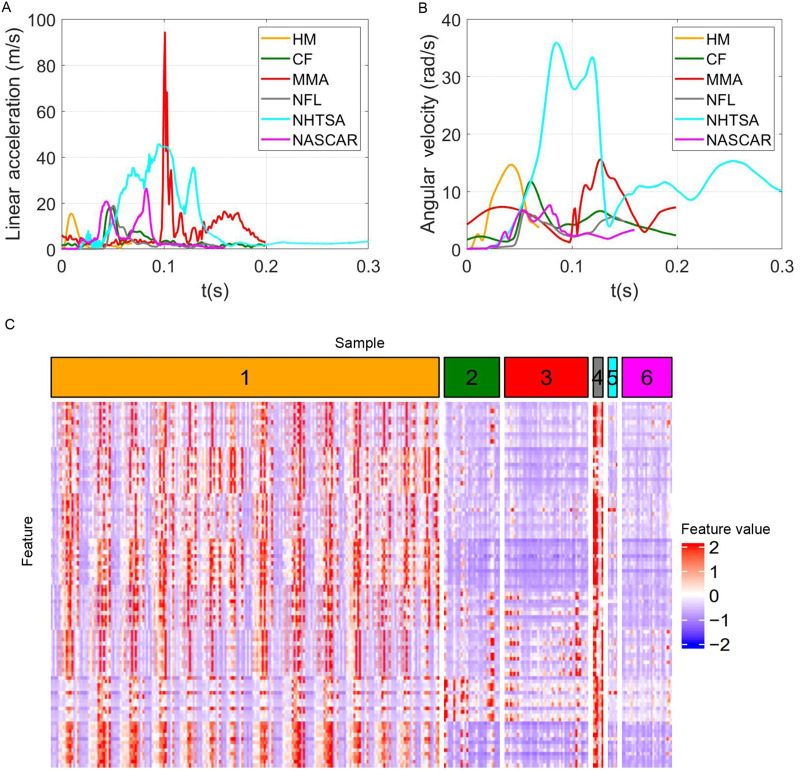
With Dr. David Camarillo: head-impact biomechanics and brain-strain modelling with machine learning, which became five co-authored papers.跟随 David Camarillo 教授:用机器学习研究头部撞击生物力学与脑应变建模,最终有五篇合著论文。
Selected work研究
A 3D lung lesion variational autoencoder三维肺部病灶变分自编码器
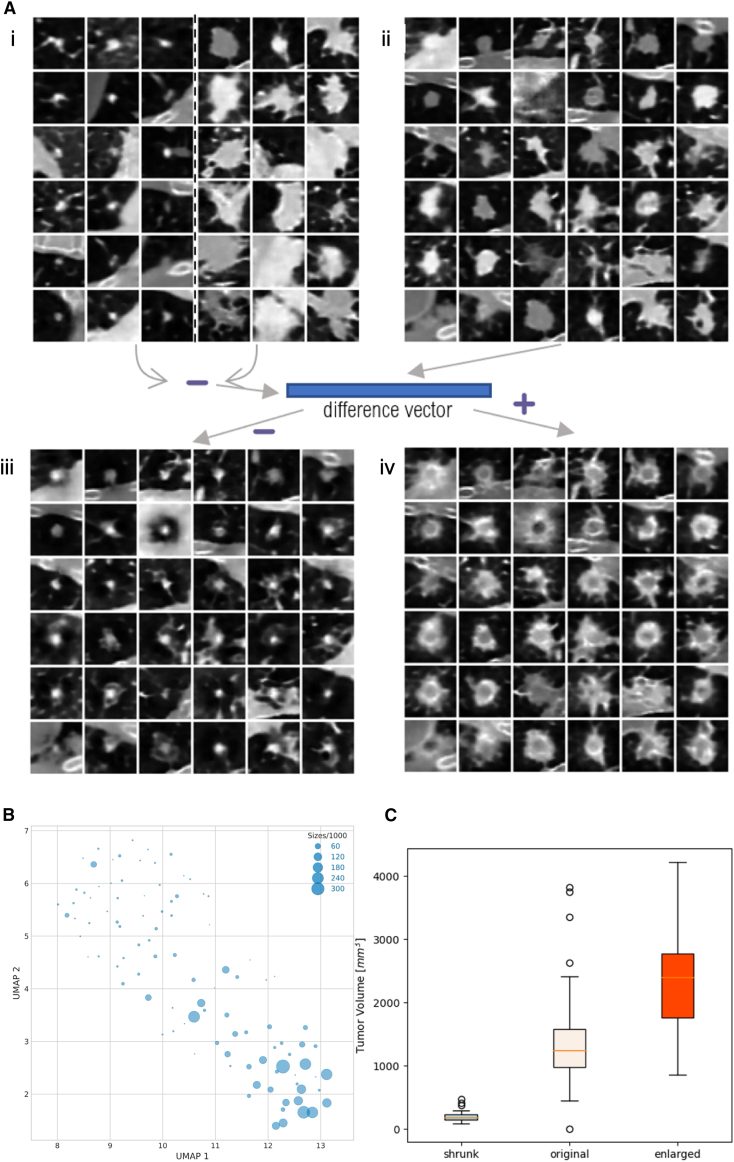
A 3D β-VAE that learns lung-tumour morphology from unlabelled CT — no manual labels — reconstructing nodule volumes at SSIM 0.774 and PSNR 26.1 while compressing them into a compact latent code. Individual latent dimensions turn out to track clinical characteristics such as nodule size, so moving along them synthesises plausible lesions; the same embeddings, transferred to an independent radiogenomic cohort, predict pathological nodal stage and KRAS mutation status on par with fully supervised models.一个三维 β-VAE,不用人工标注,直接从无标签 CT 中学习肺部肿瘤形态:重建结节体数据的 SSIM 为 0.774、PSNR 为 26.1,同时把它压缩成一段紧凑的隐编码。隐空间的单个维度与结节大小等临床特征高度相关,沿着这些方向移动即可合成看起来合理的新病灶;把同一套嵌入迁移到独立的影像基因组队列上,对病理淋巴结分期与 KRAS 突变状态的预测可与全监督模型持平。
PYTORCH · β-VAE · RADIOGENOMICSPYTORCH · β-VAE · 影像基因组学
Glaucoma detection by supervised pre-training on intermediate phenotypes以中间表型做有监督预训练的青光眼检测
Pre-training on a clinically meaningful intermediate marker — the vertical cup-to-disc ratio — rather than on ImageNet or a self-supervised proxy. A multi-task setup learns diagnosis and VCDR regression together on AIROGS, then transfers to six independent cohorts (DRISHTI, G1020, ORIGA, PAPILA, REFUGE1, ACRIMA). It beats out-of-domain and self-supervised pre-training on every backbone tried: ResNet-18, DINOv2 and RETFound.预训练的目标不是 ImageNet,也不是某个自监督代理任务,而是一个临床上真正有意义的中间指标——垂直杯盘比(VCDR)。模型在 AIROGS 上以多任务方式同时学习诊断分类与 VCDR 回归,再迁移到六个独立队列(DRISHTI、G1020、ORIGA、PAPILA、REFUGE1、ACRIMA)。在试过的每一个骨干网络上——ResNet-18、DINOv2 与 RETFound——它都优于域外预训练与自监督预训练。
PYTORCH · MULTI-TASK · RETFOUND / DINOV2PYTORCH · 多任务 · RETFOUND / DINOV2
Benchmarking chest X-ray diagnosis models across multinational datasets跨国数据集上的胸片诊断模型基准评测
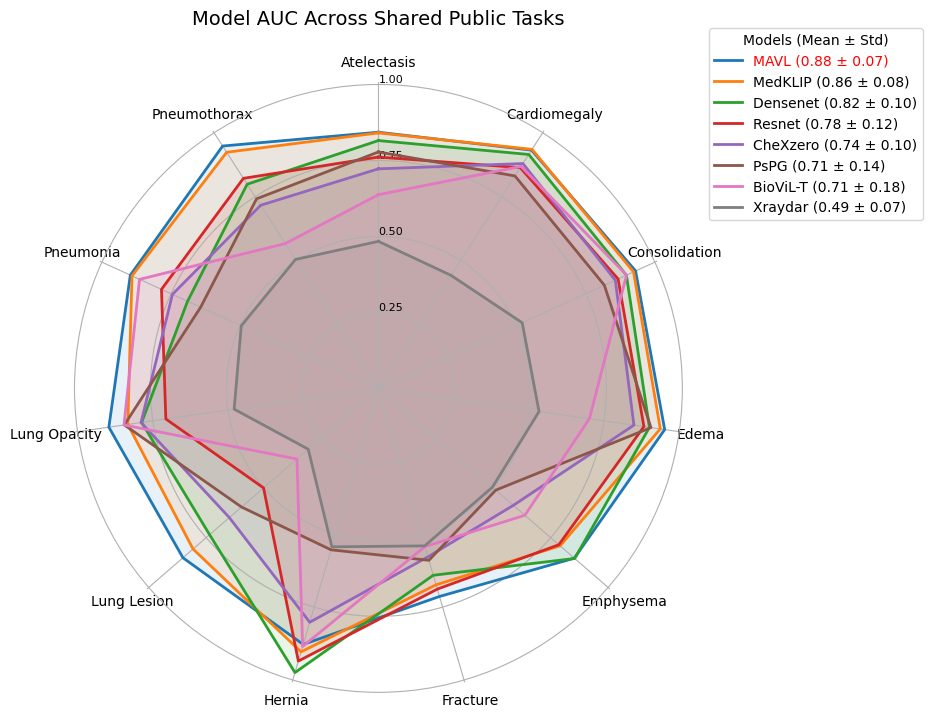
Do vision–language foundation models actually generalise better than a plain CNN? Five of them (CheXzero, BioViL-T, MAVL, MedKLIP, PsPG) and three CNNs (DenseNet, ResNet, X-Raydar) put through 37 standardised classification tasks over six public datasets from the USA, Spain, India and Vietnam, plus three previously unreleased hospital datasets from China. Co-first author; submitted to The Lancet Digital Health.视觉—语言基础模型是否真的比普通 CNN 泛化得更好?把五个基础模型(CheXzero、BioViL-T、MAVL、MedKLIP、PsPG)与三个 CNN(DenseNet、ResNet、X-Raydar)放在 37 项标准化分类任务上评测,数据来自美国、西班牙、印度与越南的六个公开数据集,外加三个此前未公开的中国医院数据集。共同第一作者;已投稿 The Lancet Digital Health。
FOUNDATION MODELS · EXTERNAL VALIDATION基础模型 · 外部验证
AI-based CT triage of COVID-19 patients基于人工智能的 COVID-19 患者 CT 分诊
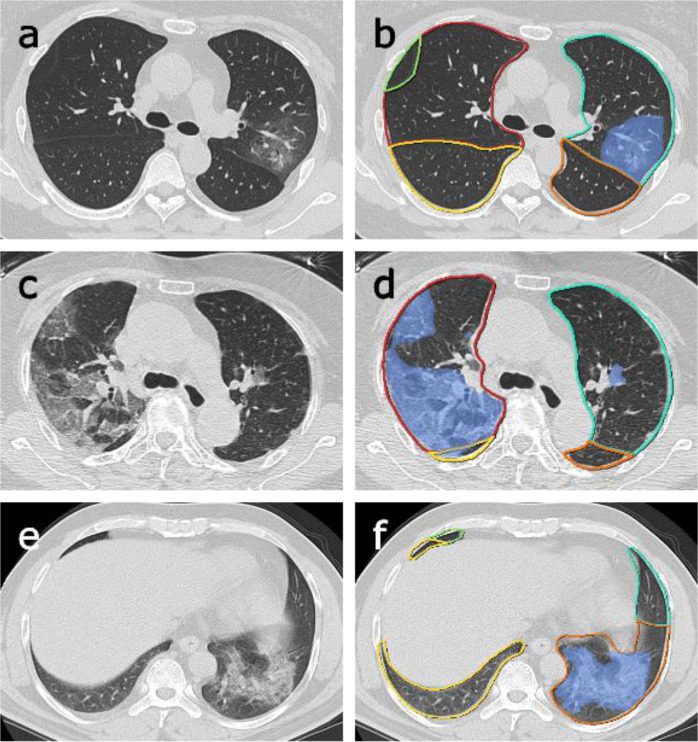
A multi-modal triage model joining 9,943 chest-CT radiomic features to clinical and laboratory records, predicting the outcomes that decide care — ICU admission, mechanical ventilation, death. Trained on a multi-hospital cohort of 1,662 patients and externally validated on 1,362 more, at AUROC ~0.85—0.94 across tasks.一个多模态分诊模型,把 9,943 项胸部 CT 影像组学特征与临床及实验室记录联合起来,预测真正决定治疗方案的结局——ICU 收治、机械通气与死亡。在 1,662 例患者的多中心队列上训练,并在另外 1,362 例上做外部验证,各任务 AUROC 约 0.85—0.94。
RADIOMICS · MULTI-MODAL · SURVIVAL影像组学 · 多模态 · 生存分析
Multi-contrast MRI registration with a realistic flow field带真实形变场的多对比度 MRI 配准
Ported SynthMorph from TensorFlow to PyTorch and trained variants with Jacobian and cycle-consistency losses to fight unrealistic flow fields and over-smoothing in the VoxelMorph family. ~40% SSIM and ~50% PSNR improvement over baseline on BraTS and Lumbar-Spine.把 SynthMorph 从 TensorFlow 移植到 PyTorch,训练了带雅可比与循环一致性损失的多个变体,用来抑制 VoxelMorph 系列中不真实的形变场与过度平滑。在 BraTS 与腰椎数据上,SSIM 较基线提升约 40%,PSNR 提升约 50%。
PYTORCH · SYNTHMORPH · VOXELMORPHPYTORCH · SYNTHMORPH · VOXELMORPH
Deep learning based image co-registration quality control基于深度学习的图像配准质量控制
A self-supervised classifier for registration quality on 3D MRI pairs, trained on synthetically mis-registered volumes from an affine plus deformable augmentation pipeline — the labelled failure cases don't exist in the wild, so we manufactured them. Trained on synthetic contrasts alone, it generalises to real brain and spine MRI better than a model trained on either of them.一个针对三维 MRI 图像对的自监督配准质量分类器,训练数据来自仿射加形变增强流水线合成的错配体数据——真实世界里没有带标注的失败样本,于是我们自己造。只用合成对比度训练的模型,在真实脑部与脊柱 MRI 上的泛化性反而好过在其中任一数据集上训练的模型。
PYTORCH · 3D CNN · SELF-SUPERVISIONPYTORCH · 3D CNN · 自监督
Head-impact kinematics and brain-strain prediction头部撞击运动学与脑应变预测
Five co-authored papers on what measurable head kinematics can and cannot say about brain injury: impact subtyping from the spectral densities of the kinematics (J. Sport Health Sci. 2023), piecewise multivariate linearity between kinematic features and the cumulative strain damage measure (Ann. Biomed. Eng. 2022), how far brain injury criteria and simulated strain diverge across impact types (J. R. Soc. Interface 2021), the measurement time window needed for reliable strain and strain-rate estimates, and a statistical reading of which kinematic features actually carry the prediction.五篇合著论文,讨论可测量的头部运动学到底能、以及不能说明脑损伤的哪些方面:基于运动学功率谱密度的撞击亚型划分(J. Sport Health Sci. 2023);运动学特征与累积应变损伤指标(CSDM)之间的分段多元线性关系(Ann. Biomed. Eng. 2022);不同撞击类型下脑损伤判据与仿真应变的分歧程度(J. R. Soc. Interface 2021);可靠估计应变与应变率所需的测量时间窗;以及从统计角度看究竟哪些运动学特征真正承担了预测。
MACHINE LEARNING · BIOMECHANICS · STATISTICS机器学习 · 生物力学 · 统计
Lumos-ToolKitLumos-ToolKit
My own PyTorch-Lightning and MONAI toolkit for training, logging and inference — the parts of medical imaging research nobody wants to write twice. Not released yet; the repository is still private while it is cleaned up.我自己写的一套基于 PyTorch Lightning 与 MONAI 的训练、日志与推理工具包,覆盖医学影像研究里没人想写第二遍的那些部分。尚未发布,仓库仍是私有的,还在整理中。
PERSONAL · OPEN SOURCE · PYTHON个人项目 · 开源 · PYTHON
Accepted abstracts会议摘要
Education教育
Skills技能