NOTE · 2020笔记 · 2020
Store Almost Any Objects of Python in Files
Cache outputs of time consuming code results
The module pickle implements binary protocols for serializing and de-serializing a Python object structure. We can store almost any type of object of Python using pickle.
Quick Example
For example, we want to save a dictionary dict_obj to file.
# Save file
def saveFile(obj):
    out_file = open('obj.pickle','wb')
    pickle.dump(obj, out_file)
    out_file.close()

# Read file
def readFile(obj_file_name):
    file = open(obj_file_name, 'rb')
    obj = pickle.load(file)
    return obj

>>> dict_obj = {'itemA': ['item', 'A'], 'itemB':[1, 3]}
>>> saveFile(dict_obj)
>>> obj_file_name = 'obj.pickle'
>>> readFile(obj_file_name)
{'itemA': ['item', 'A'], 'itemB':[1, 3]}
Related Package: JSON
Comparison of pickle and JSON
There are some fundamental differences between the pickle protocols and JSON.
JSON is a text serialization format (it outputs Unicode text, although most of the time it is then encoded to
utf-8), while pickle is a binary serialization format;JSON is human-readable, while pickle is not.
JSON is widely used outside of Python ecosystem, while pickle is Python-specific.
JSON, by default, can only represent a subset of the Python built-in types, and no custom classes; pickle can represent an extremely large number of Python types.
- pickle — Python object serialization
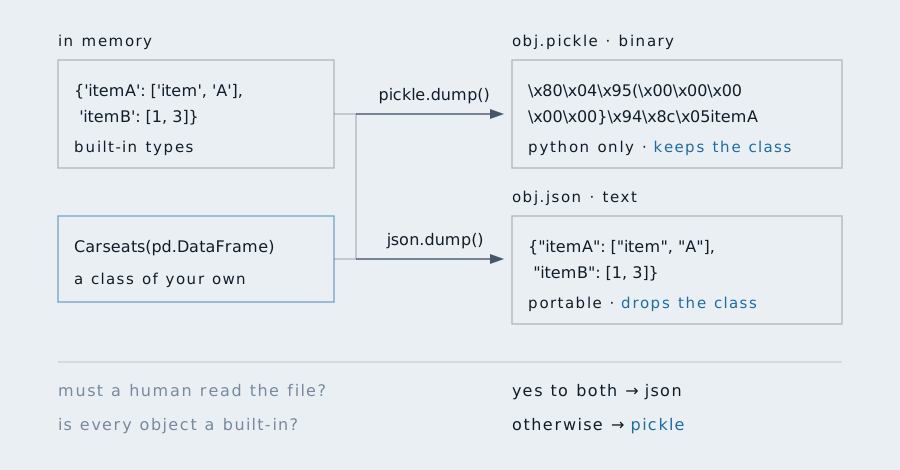
The trade is the same object leaving memory by two different doors. json.dump produces something you can open in any editor and read on any platform, at the cost of flattening everything down to a handful of built-in types. pickle.dump produces bytes only Python can interpret, and in exchange the object comes back as the class it was.
JSON Example
Note that JSON can only store a subset of object of Python. Dictionary is one of them.
import json

# Store dictionary
>>> with open('obj.json', 'wb') as file:
...     json.dump(dict_obj, file)

# Read in dictionary file
>>> file = open('obj.json', 'rb')
>>> obj = json.load(file)
>>> obj
{'itemA': ['item', 'A'], 'itemB':[1, 3]}
Suggestions on Choosing Pickle and JSON
As we can see, pickle and JSON nearly shared the same syntax and complexity in terms of storing and loading files. The major differences are
- Whether do we need readable file format;
- Whether the object we want to save is a python build-in object;
If the answers are ‘Yes’ to both questions, we should choose JSON. Otherwise, pickle would be the better option here.